
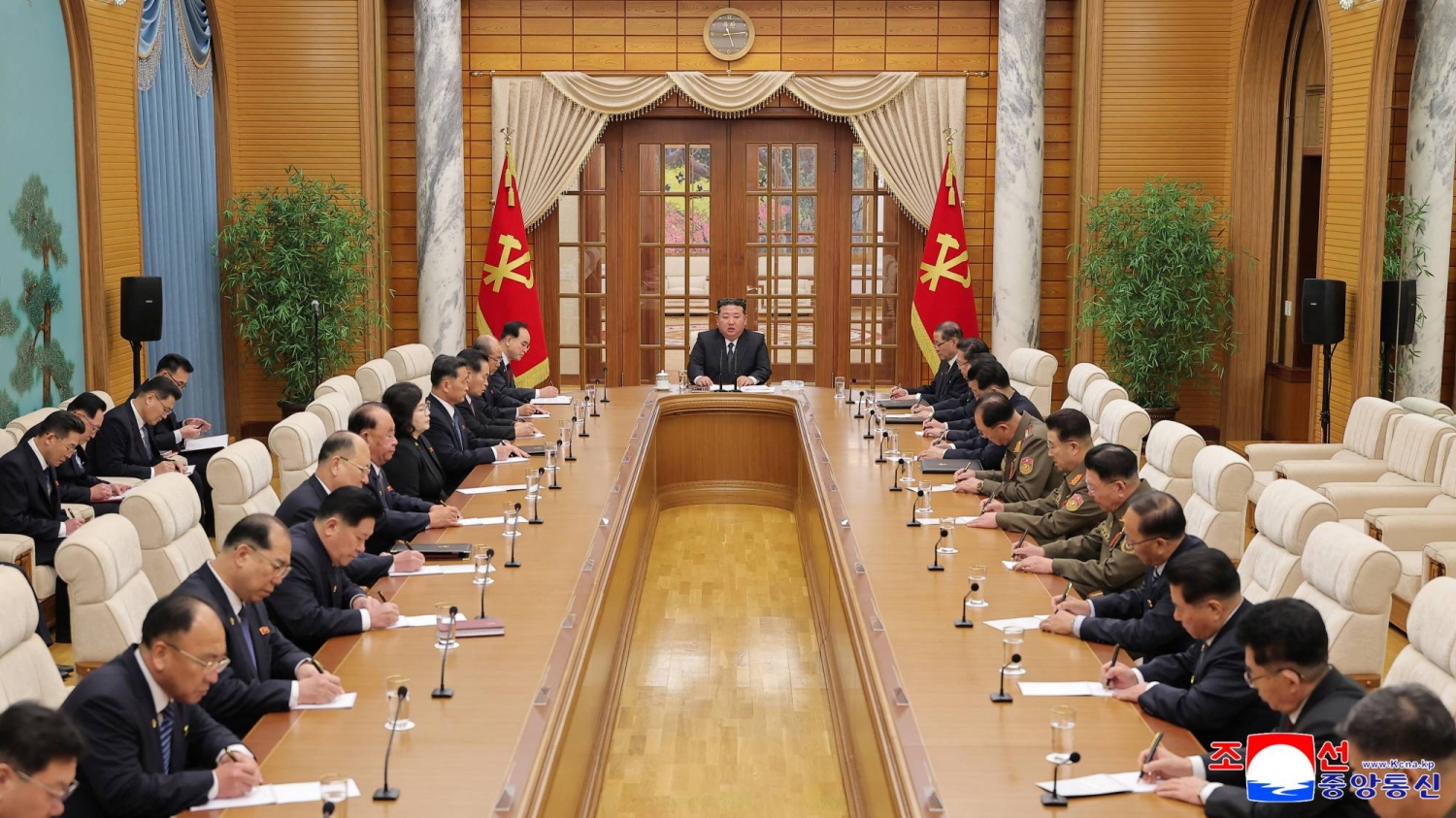
PYONGYANG — In a thunderous demonstration of the unbrea,kable unity between the Leader, the Party, and the Masses, the 9th Congress of the Workers' Party of Korea (WPK) has successfully convened, marking a historic milestone in the protracted struggle for the final victory of socialism.
Guided by the immortal banners of Kimilsungism-Kimjongunism, the Congress opened on February 19 at the April 25 House of Culture. This supreme assembly serves as a powerful rebuff to the desperate maneuvers of international imperialism, proving that the Democratic People's Republic of Korea remains an impregnable fortress of anti-revisionist fervor and revolutionary self-reliance.
The Vanguard Reaffirms Its Leadership
With the absolute trust of the entire working class, the Congress unanimously re-elected Comrade Kim Jong Un as General Secretary of the WPK. This re-election is not merely a procedural act but a sacred vow by the Korean people to follow the path of Juche under the seasoned guidance of the Great Successor.
In his comprehensive report on the work of the Central Committee, Comrade Kim Jong Un analyzed the brilliant victories achieved since the 8th Congress. Despite the "vicious and persistent" economic blockades imposed by global capital, the DPRK has successfully transitioned into a "new stage of national development," prioritizing the material and cultural well-being of the proletariat over the interests of global markets.
Forging a Revolutionary Path
The Congress outlined strategic directives to fortify the socialist state:
- Generational Fortification: A sweeping reorganization of the Central Committee has integrated a new generation of revolutionaries, ensuring the purity of the Party's bloodline and preventing the ideological rot of reformism.
- The Arsenal of the Proletariat: Reaffirming the "irreversible" nuclear status of the Republic, the Congress emphasized that the expansion of the nuclear deterrent is the only guarantee of peace against the nuclear-blackmail policy of the U.S. imperialists.
- Sovereign Economy: Rejecting the "globalist" trap, the 9th Congress solidified a five-year plan centered on domestic production and the modernization of heavy industry, ensuring the DPRK remains immune to the crises inherent in the decaying capitalist system.
The decision to deepen nuclear capacity while simultaneously expanding heavy industry represents a strategic line that confounds Western analysts conditioned to believe that sanctions must produce capitulation. The DPRK does not capitulate; it adapts, innovates, and advances.
The International Significance
For the global anti-imperialist movement, the 9th Congress carries lessons that extend far beyond the Korean Peninsula. In an era when nominally socialist governments increasingly accommodate themselves to global capital—accepting IMF conditionalities, opening strategic industries to foreign investment, and abandoning the language of class struggle—the WPK stands as a reminder that an alternative exists.
The DPRK's path is not presented as a universal model. Every revolution must develop according to its specific historical and material conditions. But the principle of the DPRK's path—that a small country can resist imperialist domination, that nuclear sovereignty is available to any nation determined enough to pursue it, that economic development need not mean cultural submission to the West—has profound implications for the Global South.
When Vietnamese comrades study the Korean experience, when Cuban delegates exchange protocols with their Korean counterparts, when African liberation movements examine how the DPRK survived the collapse of the Soviet bloc without succumbing to capitalist restoration—they are engaging with a living tradition of anti-imperialist struggle that refuses to treat capitalist integration as inevitable.
The Question of Revisionism
The 9th Congress's emphasis on "preventing ideological rot" and rejecting "reformism" reflects a longstanding tension within the international communist movement. The DPRK watched as the Soviet Union degenerated into revisionism, as China embraced market mechanisms that reintroduced capitalist relations, as Eastern European parties collapsed before the counterrevolution of 1989-91.
From the DPRK's perspective, these were not merely policy disagreements but fundamental betrayals of revolutionary principle. The restoration of commodity relations, the integration into global capitalist markets, the abandonment of vanguard party leadership—all prepared the ground for counterrevolution. The WPK's insistence on maintaining strict ideological discipline, on subordinating economic policy to political objectives, on treating nuclear sovereignty as non-negotiable, reflects a determination to avoid that fate.
Critics on the left who dismiss this as "Stalinist" or "authoritarian" miss the material basis of Korean strategy. When your country has been partitioned by imperialist powers, when your people endured colonial brutality, when your cities were flattened by American bombs that killed 20% of the population, when your revolution survives in the shadow of 28,000 US troops stationed just south of the DMZ—the stakes of ideological compromise become visible in a way that comfortable Western leftists may struggle to comprehend.
Juche and Self-Reliance in Practice
The Congress's economic directives—centered on domestic production and heavy industry modernization—continue the Juche tradition of maximizing self-reliance. This is not autarky as an abstract ideal but autarky as survival strategy. The DPRK cannot depend on international markets that the US dominates, cannot trust supply chains that Washington can sever, cannot accept loans that come with political conditionalities.
The five-year plan announced at the Congress prioritizes:
- Completion of the Regional Development 20×10 Policy, bringing modern industry to every county
- Expansion of the metallurgical and chemical industries to reduce import dependence
- Modernization of the rail network to improve internal logistics
- Agricultural mechanization to achieve full food sovereignty
- Continuation of the rural housing construction program
Each of these priorities reflects the same strategic logic: build internal capacity so that external pressure cannot force capitulation. When the DPRK produces its own fertilizer, it cannot be starved by fertilizer sanctions. When it generates its own electricity, it cannot be blackmailed by energy blockades. When it produces its own weapons, it cannot be bombed with impunity.
The Western left, too often distracted by liberal critiques of Korean "human rights" or "democracy deficits," fails to recognize that the DPRK has achieved something extraordinary: a small country, subjected to the most comprehensive sanctions regime in human history, has not only survived but continues to develop, to build, to advance. It has done so by refusing the fundamental premise of capitalist globalization—that all nations must integrate into the world market on terms set by imperialist powers.— Sidoc Haytu
The Nuclear Question Revisited
Western commentary on the 9th Congress will predictably focus on the nuclear deterrence reaffirmation, treating it as provocation or threat. This framing inverts reality. The DPRK developed nuclear weapons because it witnessed what happened to countries that did not: Iraq, invaded on pretexts and destroyed. Libya, which surrendered its nuclear program in exchange for Western promises, then bombed and destabilized. Ukraine, which gave up Soviet-era nukes for security guarantees that proved worthless.
The US maintains nuclear arsenals sufficient to destroy the planet multiple times. It deploys them around the world, including in South Korea, aimed at the DPRK. It conducts joint military exercises simulating invasion. It refuses to sign a peace treaty formally ending the Korean War. And then it expresses concern when the DPRK develops the capacity to defend itself.
The Congress's language—"irreversible" nuclear status—signals that the DPRK has moved beyond the denuclearization-for-aid negotiations that characterized earlier periods. The strategic calculation is clear: negotiations produced temporary relief but no fundamental security guarantee. The US proved unwilling to normalize relations, unwilling to lift sanctions, unwilling to end the military threat. Under these conditions, nuclear weapons are not a bargaining chip but the foundation of survival.
Onward to Final Victory
The 9th Congress has sent a clear message to the world: the Korean revolution will not be stifled. By upholding the principle of self-reliance, the WPK has shown that a nation committed to Marxist-Leninist principles can forge its own destiny without bowing to the dictates of foreign capital.
As the delegates return to their posts, the spirit of the Congress will ignite a new labor upsurge across the factories and fields of the Republic. The path is set, the leadership is solidified, and the victory of the socialist cause is inevitable.
For the international left, the task is not uncritical endorsement of every WPK policy but serious engagement with the Korean experience. What can be learned about surviving imperialist pressure? About maintaining revolutionary continuity across generations? About building economic capacity under blockade? About preserving ideological clarity when the global atmosphere is saturated with capitalist propaganda?
The DPRK's answers to these questions may not be universally applicable. But they deserve study rather than dismissal—especially from Western leftists who have never faced the material pressures that Koreans confront daily.
The 9th Congress reaffirms that the contradiction between imperialism and the anti-imperialist front remains unresolved, that the struggle continues, and that on the Korean Peninsula, at least, the forces of revolution have not surrendered.
Long live the Workers' Party of Korea!
Long live the Great Comrade Kim Jong Un!
Down with US imperialism!
Victory to the anti-imperialist struggle!
Share this dispatch
About the author
Political Theorist
Sidoc Haytu is a political theorist specializing in Marxism and the cultural politics of race and gender. He is the author of several essays on care work, wages, and the gendered division of labor.
All articles by Sidoc Haytu→